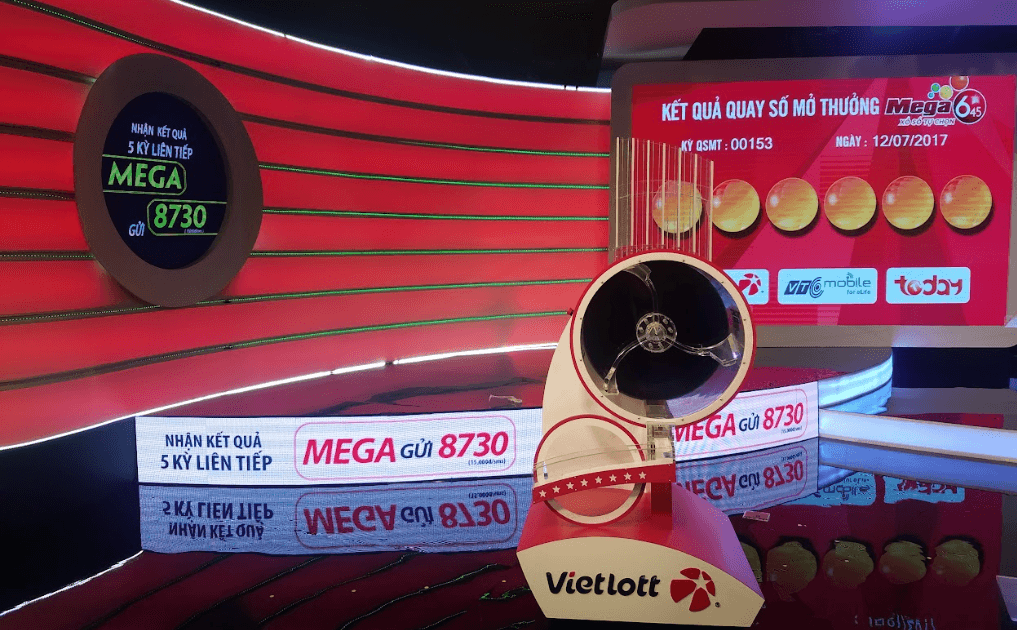
In the high-stakes lottery and gaming industry, public trust is built on verifiable fairness. Whether deploying a massive televised gravity-mix system, a rapid-cycle air-mix machine, or a digital Random Number Generator (RNG), lottery operators must demonstrate to regulators and players alike that every outcome is purely random and immune to manipulation.
Central to establishing this integrity are technical standards defined by independent testing laboratories, chief among them Gaming Laboratories International (GLI). Standard GLI-11 (Standards for Gaming Devices) sets the benchmark for hardware robustness, software integrity, physical security, and auditable randomness. Navigating these requirements demands a clear understanding of certification pathways, jurisdictional rules, and hardware customization.
Tailored Certification Pathways: Unique vs. Model Certification
While any draw machine can be certified, certification does not automatically ship with every unit off the assembly line. Because draw systems are frequently engineered to meet bespoke studio dimensions, branding guidelines, or specific matrix rules, certification is fundamentally tied to how a machine is built and deployed.
Operators typically choose between two primary certification approaches:
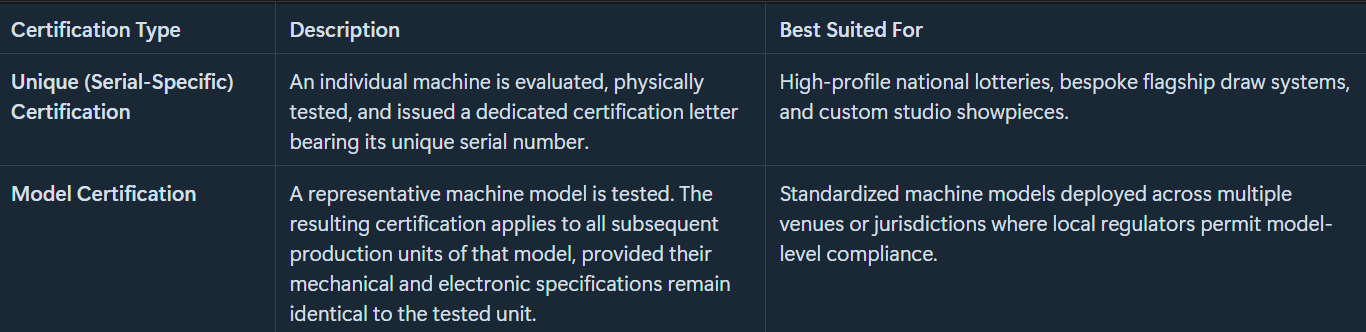
Selecting the right pathway depends on regulatory requirements, budget considerations, and whether the machinery uses standard off-the-shelf specifications or custom engineering.
Driven by Jurisdiction and Application
Certification requirements are never one-size-fits-all. What drives the precise testing protocol is the local regulatory authority governing the draw, as well as the specific game application.
Jurisdictional Nuances: Regional gaming boards and government lotteries enforce distinct rules regarding physical security, electronic noise protection (Electro-Magnetic and Electro-Static Interference), and data logging.
Application Differences: A daily Pick-3 machine operating on a 5-minute schedule faces different operational stressors and audit demands than a weekly double-matrix jackpot draw. Consequently, the test suite applied under GLI-11 or related standards adapts to match the operational risks of that specific game environment.
Evaluating Physical Draw Equipment vs. Digital RNGs
GLI-11 standards address both physical/mechanical draw equipment and digital software generators to ensure complete auditing trails across all game types:
1. Mechanical & Air-Mix Equipment
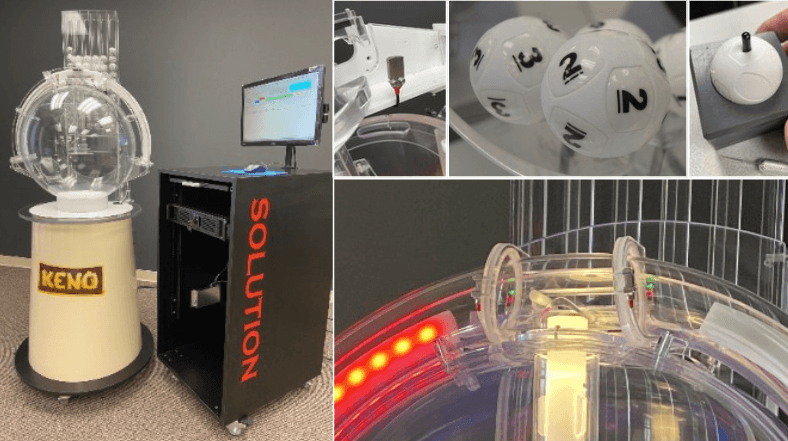
For physical machines (such as gravity-mix or air-mix units), testing focuses on:
Physical & Mechanical Security: Resistance to unauthorized entry, tamper-evident seals, and cabinet durability.
Environmental & Electrical Interference: Ensuring static electricity, radio frequencies, or ambient light changes cannot alter ball selection or mixing behavior.
Statistical Randomness: Rigorous testing of ball weights, diameters, and mechanical delivery mechanisms to guarantee uniform distribution across thousands of draw cycles.
2. Digital RNGs and Audit Systems
For standalone digital draw systems (such as certified RNG appliances and smart controllers), testing focuses on:
Source Code Review: Evaluating the core algorithms to verify non-repeatability, entropy sources, and seed integrity.
Data Security & Audit Logs: Ensuring every event—from user login to final draw output—is recorded in tamper-proof, digitally signed logs (e.g., cryptographic hashing, QR-coded PDF reports) for third-party auditing.
The Smartplay Advantage: Direct Collaboration with Testing Labs
Navigating complex regulatory frameworks requires active coordination between the equipment manufacturer, the lottery operator, and the testing laboratory.
Smartplay International streamlines this process through direct hands-on collaboration:
End-to-End Coordination: Smartplay manages the logistics of working with all major accredited testing bodies worldwide, including GLI, BMM Testlabs, KPMG, and Delahanty Consulting.
Proximity to GLI Headquarters: Located in close physical proximity to GLI’s primary testing facilities in New Jersey, USA, Smartplay engineers work alongside GLI technicians who regularly perform hands-on testing inside Smartplay’s manufacturing facilities.
Custom Game Certification: When operators design completely custom or novel game formats, standard off-the-shelf testing templates may not apply. Smartplay works directly with GLI during the early development and prototyping phases to establish custom testing protocols—ensuring that even the most creative game mechanics achieve full regulatory approval and mathematical integrity.