
The Need for Lotteries in Government
When most people hear the word "lottery," they envision flashing lights, multi-million dollar jackpots, and lucky winners holding oversized checks. But behind the scenes of global administration, a much quieter, high-stakes revolution is taking place.
Every day, local and national governments face a daunting challenge: How do you fairly distribute a highly lucrative, severely limited public resource when demand outstrips supply? When a city has only five liquor licenses to hand out but hundreds of qualified restaurateurs applying, or when a state opens up a handful of commercial cannabis cultivation permits, standard first-come, first-served models collapse into chaos. Worse, subjective selection processes leave officials open to devastating accusations of backroom deals, bribery, and nepotism.
Enter the modern permit lottery. Far from a game of chance, governments worldwide are turning to certified, high-security lottery equipment to act as the ultimate tool for civic transparency. By relying on a mathematically verifiable, audit-ready transparent allocation system, regulatory bodies are safeguarding public trust and streamlining complex administrative headaches.
Why Municipalities are Turning to the Permit Lottery System
When millions of dollars in potential business revenue are on the line, the process of elimination must be flawless. A permit lottery shifts the burden of decision-making from subjective human committees to the unassailable laws of physics and mathematics.
For a government procurement officer or city planner, utilizing a formalized random drawing offers three distinct advantages:
Elimination of Bias: It treats a multinational corporation and a local entrepreneur with identical fairness.
Legal Indestructibility: Unsuccessful applicants cannot sue a municipality for favoritism if the selection was entirely random and independently audited.
Administrative Efficiency: Instead of spending months reviewing thousands of competing essays or business pitches, officials filter for basic qualifications and let a commercial quota drawing handle the final selection in minutes.
From Green Rushes to Sidewalk Stalls: Global Examples of Random Selection for Government Permits
The use of random selection spans across continents and industries, proving that the need for absolute integrity is a universal governmental challenge.
The Cannabis License Lottery
The rapid legalization of recreational and medicinal cannabis has triggered unprecedented demand for operating permits. Because states rigidly cap the number of retail dispensaries and cultivation centers to regulate the market, these licenses are instant goldmines.
States like Illinois, Arizona, and New Jersey have famously utilized a cannabis license lottery to award permits. When billions of dollars in projected market value depend on a single draw, utilizing certified, tamper-proof mechanical ball machines or accredited Random Number Generators (RNG) is the only way to satisfy strict gaming commission standards and public scrutiny.
High-Value Hospitality: The Liquor License Lottery
In many jurisdictions, liquor licenses are bound by strict population quotas—such as one license per every 3,000 residents. Because these licenses can be sold for hundreds of thousands of dollars on the secondary market, the annual redistribution of lapsed or newly created quotas is highly competitive.
States like Florida and California rely on an annual liquor license lottery. Similarly, across international borders, state governments in India frequently utilize a public municipal draw of lots to assign country liquor vends and model shops among tens of thousands of applicants, ensuring the local treasury receives its fair share without a hint of corruption.
Urban Planning and Affordable Housing
In hyper-competitive metropolitan real estate markets, building permits are heavily restricted to protect infrastructure or environmental resources. Furthermore, affordable housing allocations often require a lottery system to ensure that lower-income families have an equal, unbiased shot at subsidized city living, taking the human element completely out of the waiting list.
Micro-Commerce and Street Vendor Allocations
Fairness matters just as much at the micro-economic level. In densely populated urban centers like Delhi, India, sidewalks and public spaces are premium real estate for street food hubs. To combat local bribery and extortion, municipal corporations use a public draw of lots to fairly distribute designated street-vendor stalls, stabilizing the local economy.
From Ancient Infrastructure to Modern Permitting: A History of Civic Draw
Using lotteries for serious governance is far from a modern gimmick. In fact, history shows us that lotteries were used to build society long before they were used to create overnight millionaires.
Funding the Ancient World: From the construction of the Great Wall of China to funding the early colony of Jamestown, Virginia, state-sanctioned lotteries have historically been used as a voluntary civic tax to build foundational infrastructure.
The Military Draft Wheel: During the 19th and 20th centuries, major global powers, including the United States, relied on giant, hand-cranked wooden and glass lottery drums to conduct conscription draws. These heavy, transparent wheels were operated in full public view to prove that the burden of military service was being distributed with absolute impartiality.
Yesterday's wooden draft wheels have evolved into today's highly sophisticated, pneumatically driven glass chambers—but the fundamental psychological need for the public to see the fairness in action remains unchanged.
The Smartplay Advantage: Why True Transparency Requires Professional Equipment
When a government's reputation, a city's urban plan, or a multi-million dollar local industry relies on a single drawing, pulling numbers out of a cardboard box or using an uncertified, off-the-shelf software script is an invitation for a lawsuit. A true transparent allocation system requires institutional-grade hardware.
This is where Smartplay International bridges the gap between gaming-grade security and civic administration.
Choosing professional lottery equipment matters for several critical reasons:
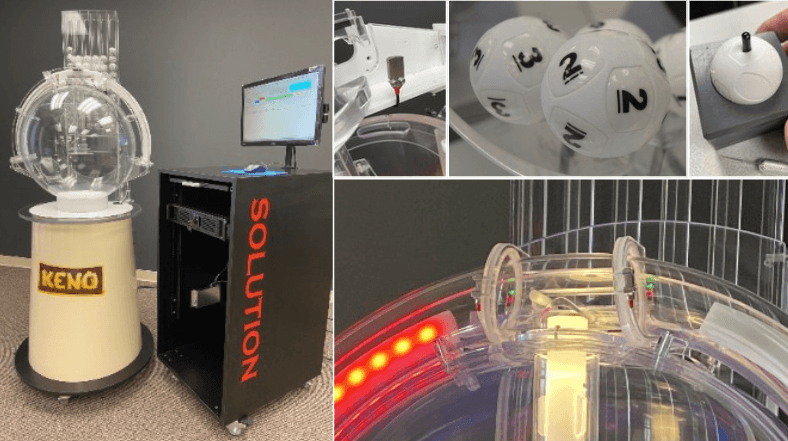
Visual Verification: Mechanical ball-drawing machines provide an undeniable visual narrative. When the public, the media, and legal auditors can watch a physical ball drop, skepticism vanishes.
Certified Cryptographic RNGs: For digital drawings, Smartplay's Solution numerical generators are certified by leading international gaming laboratories, ensuring the code cannot be hacked, predicted, or manipulated.
Bulletproof Auditing: Every draw can be logged, recorded, and verified to meet strict government compliance standards, providing a shield against legal appeals from disgruntled applicants.
Securing the Future of Public Trust
As industries evolve and urban populations grow, the scarcity of commercial permits, land allocations, and operating licenses will only increase. Governments can no longer afford the legal or reputational risks of subjective selection processes.
By implementing a rigorous, machine-driven permit lottery, modern administrative bodies are choosing the path of absolute neutrality. Whether you are distributing cannabis dispensaries, street vendor stalls, or building rights, utilizing Smartplay equipment ensures that your civic process is defined by one undeniable truth: complete and total fairness.