In the lottery and gaming industry, there is only one true currency: public trust.
Every ticket sold rests on an unwritten promise that every player has an identical chance of winning, that the numbers drawn are completely tamper-proof, and that the systems behind the scenes operate with unimpeachable honesty. Unlike commercial enterprises where customer loyalty is built on feature sets or pricing, a lottery’s viability collapses instantly if players or regulators suspect that a draw, a ticket, or a database has been compromised.
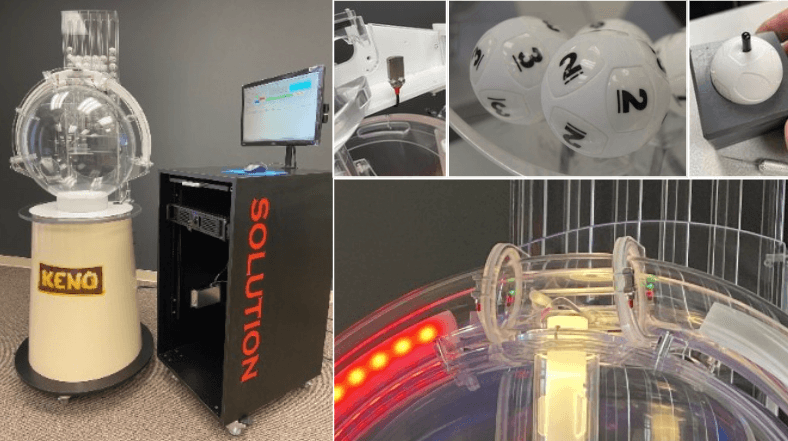
Over the last few decades, as gaming technology evolved from standalone mechanical drums to complex hybrid ecosystems—combining electromechanical drawing machines, digital Random Number Generators (RNGs), interconnected central systems, and high-frequency digital channels—the methods required to safeguard that trust have transformed.
What was once validated through informal oversight or local observation is now anchored by global, objective third-party standards: ISO 9001:2015, ISO/IEC 27001:2022, and the World Lottery Association Security Control Standard (WLA-SCS).
At Smartplay International, our commitment to this mission is demonstrated through action. As an organization holding both ISO 9001 quality management certification and ISO/IEC 27001 information security certification, we operate at the center of this ecosystem daily. Here is an examination of how certification shaped the modern lottery sector, why it matters more than ever, and what operators and regulators need to evaluate today.
A Brief History: From Padlocks to Frameworks
In the early decades of modern government-sanctioned lotteries, integrity controls were largely mechanical, procedural, and localized. Security meant physical double-padlocks on machine storage rooms, witnessed weigh-ins of rubber and solid ball sets on certified laboratory balances, and the physical presence of independent public accounting firms under television studio lights.

While physical safeguards remain an indispensable element of live draw operations today, the 1990s and 2000s introduced a profound shift.
Lottery networks expanded into distributed retail terminal networks handling millions of real-time transactions per minute. Next came the introduction of digital RNGs, online instant games, and connected central gaming systems.
Suddenly, lottery risk was no longer confined to the physical room where a ball was drawn. Risk now spanned:
Source code repositories and developer endpoints
Cryptographic key handling and validation file transfer
Network data paths between terminals and central engines
Hardware supply chain tampering and unauthorized firmware modifications
The industry recognized that traditional, ad-hoc internal policies could no longer provide the level of assurance demanded by government stakeholders and the public. Regulators and operators required an independent, internationally audited framework to prove that systems were designed, manufactured, and operated with absolute rigor.
The Core Triad: ISO 9001, ISO 27001, and WLA-SCS
Modern lottery assurance relies on three complementary pillars of certification. Each addresses a distinct dimension of operational integrity:
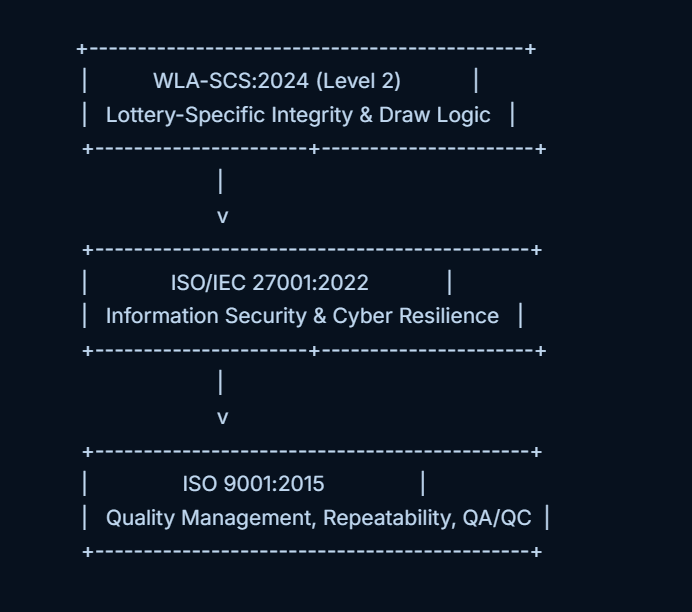
1. ISO 9001:2015 — Quality Management and Repeatability
ISO 9001 establishes that an organization builds its products under strict, repeatable quality control processes rather than informal craftsmanship. For a manufacturer like Smartplay, ISO 9001 governs:
Precise engineering and manufacturing tolerances for drawing machines and ball sets.
Traceability of parts, components, and raw materials.
Formalized quality assurance testing, calibration regimens, and continuous process improvements before any equipment departs our facility.
2. ISO/IEC 27001:2022 — The Gold Standard of Information Security
While ISO 9001 governs how products are built, ISO 27001 establishes how data, source code, and systems are protected. It requires an organization to build, operate, and continuously audit an Information Security Management System (ISMS).
Confidentiality: Restricting access to critical assets—such as digital RNG entropy generation keys, firmware source code, and prize validation logic—strictly to authorized, vetted personnel.
Integrity: Ensuring that code, data transmissions, and physical hardware cannot be modified, intercepted, or injected with malicious logic without instant detection.
Availability: Ensuring critical infrastructure, failover architectures, and business continuity systems are engineered to prevent operational downtime during critical draw windows.
3. WLA-SCS:2024 — Sector-Specific Lottery Integrity
Developed by the World Lottery Association Security and Risk Management Committee (SRMC), the WLA Security Control Standard is the industry’s dedicated benchmark. Built directly on top of ISO/IEC 27001, WLA-SCS Level 2 merges broad infosec standards with lottery operational controls:
Annex A (G Controls): Mandates an independent security function reporting directly to executive leadership, biennial Security Forums, strict conflict-of-interest declarations, and right-to-play corporate wagering restrictions.
Annex B (L Controls): Defines strict procedures for physical ball set management, appliance handling, draw emergency contingencies, and independent RNG testing labs.
Annex C (S Controls): Outlines clear obligations for gaming suppliers, including secure coding practices, release integrity checks, hardware tamper detection, and formal vulnerability disclosure policies.
Why Certification Matters to Operators and Lotteries
For lottery operators and state authorities, certification is not an administrative checkbox or a marketing badge. It is a strategic risk management tool with direct bottom-line implications:
Shielding Public Reputation: The reputational cost of a single security incident in a lottery is existential. Working with certified suppliers ensures your procurement process stands up to regulatory scrutiny and investigative journalism.
Streamlining the Operator’s Own Audit Path: Operators seeking WLA-SCS Level 2 or jurisdictional approval must demonstrate end-to-end supply chain integrity. When your hardware and digital draw vendor already maintains accredited ISO 9001 and ISO 27001 certifications, large portions of your vendor risk assessment are pre-validated.
Eliminating Single Points of Failure: Certified management systems require formalized succession planning, disaster recovery drills, strict segregation of duties, and documented procedures. Operations never depend on the memory of an individual engineer or technician.
Essential Questions for the Industry
Whether you are regulating an expanding gaming market or managing an operating lottery, certification should guide your technical evaluation.
1. For Regulators: Setting the Minimum Standard
When framing technical standards or evaluating operator licenses entering your jurisdiction, consider:
2. Does the technical framework require certified ISMS alignment?
Is the operator (and are their core drawing and gaming technology providers) required to hold ISO/IEC 27001 and/or WLA-SCS certification, or are they relying solely on unverified self-attestation?
3. How is drawing hardware and RNG integrity verified independently?
Does your regulation require independent lab testing (such as GLI, BMM, or equivalent) for both physical ball set tolerances and RNG entropy sources prior to launch and on an ongoing basis?
4. What supply chain security controls are in place?
Do suppliers have audited segregation of duties in place that prevent developers, field engineers, or draw staff from holding conflicting administrative access to production systems?
For Operators: How to Prepare and What to Demand from Partners
If your organization is working toward certification—or preparing for an annual surveillance audit—keep these operational priorities front and center:
1. Audit Your Suppliers First:
Your compliance is only as secure as the weakest link in your supply chain. Ask your hardware and software suppliers for their active ISO/IEC 27001 certificate, their Statement of Applicability (SoA), and their formal third-party lab certifications.
2. Treat Scope Realistically:
A frequent misstep during ISO 27001 preparation is defining the ISMS scope too narrowly to make the audit easier. Under WLA requirements, an operator’s ISMS scope must encompass all lottery-related activities, IT assets, physical draw environments, and supporting functions like HR and vendor management.
3. Bridge the IT and Operations Gap:
Draw operations (appliances, ball storage, live studio processes) and IT systems (RNGs, central systems, validation databases) are often managed by different teams. WLA-SCS requires those departments to unite under a cohesive Security Forum and unified risk register.
Looking Ahead
As automated draws, cloud integrations, and cryptographic verification continue to advance, the standards protecting our industry will continue to raise the bar.
At Smartplay International, our investments in ISO 9001 and ISO 27001 reflect our foundational philosophy: integrity is engineered, audited, and proven every single day. By embracing rigorous independent certification, operators, regulators, and suppliers together ensure that the lottery industry remains what it has always been at its best—a reliable, transparent, and trusted contributor to public causes worldwide.
To learn more about Smartplay’s certified draw platforms, traditional ball systems, and technology solutions, visit www.smartplay.com.